If I’m going to be dancing, I might as well (try to) look good doing it. This is my space to geek out about all things swing dancing (my travels, leading, music, style (clothing) and whatever tickles my fancy).
Putting together looks is much easier when you’ve got great examples from which to draw. I follow a couple photographers, blogs and Tumblrs that I look at most days, saving the photos that make a big impression on me.
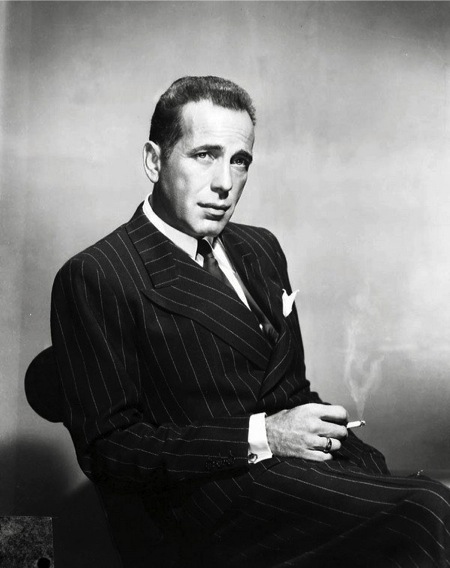
Try to tell me that Humphrey Bogart doesn’t make an impression on you; I won’t believe you. (Photo by Ned Scott).
It’s always interesting (to me at least) to notice the subtle cycles in men’s style through the years. There is rarely anything “new” when it comes to men’s style, only variations in proportion. Notice the true 3-button stance, wider lapels (compared to today), and nice hats.
Some cool (in multiple senses of the word) Spring/Summer shoes.
These photos are from My Vintage Vogue, a website with scans from pages of (you guessed it) vintage Vogue magazines. The website focuses on scans of women’s fashion, organized by decade and model/movie star, but there is a page dedicated to men.
Anyone who knows me knows that I love lindy hop and other swing dancing. I would dance every day if I could. So now and then, I wonder what it would be like to be an instructor who travels around the world to teach lindy hop. Would I do it? Actually, this boils down to a more basic question: Would I pursue any of my passions as a profession?
I found his second point on mistakes to be the best insight of the article. Basically, one must be professional. It sounds very simple and obvious because it is simple and obvious. If you want to turn your passion into a career, you must treat it like a job, not a hobby. This means working hard and pursuing success. As Dax answer later in the interview, “Never stop developing your craft and your business will never die.”
I don’t think I’ll ever be a professional international swing instructor, but I think it’s fascinating to see what takes to get there. It’s good advice either way.
Last night, I spent an hour working on camel walks; driving myself crazy trying to figure out some unfamiliar footwork variations.
Camel walks are a jazz step that I used to look at and wonder “how the heck do they make their legs do that?”
Here is the video that first inspired me to learn them. It’s from the 2009 Old School dance battle in Sweden pitting jazz dancers (the Harlem Hot Shots) versus hip hop dancers (Streets R us). One of the gals from the Harlem Hot Shots enters the arena by doing some very slick camel walks at :53 seconds into the clip, then breaks into some mean squat charleston (which is next on my list to learn).
I recommend watching the rest of the series too. It’s a great battle.
It’s that “how the heck?” feeling that inspired me to watch this video over and over (and over) until I could do it myself.
The problem with this video (besides the music) is that you don’t get too much instruction; you have to figure it out by watching him. (Just remember that no matter what it looks like, you step one foot after the other. right, left, right, left... ).
Here’s the video that had me camel walking around the room for an hour this time. It’s Stefan and Bethany’s routine from the Jump Session Show at Camp Jitterbug 2010. I’ve always loved their choreography. They have such a loose, relaxed quality to their movements.
I had to watch it over and over (and in slo-mo to be honest) to figure out what they were doing. The camel walks start at 1:38.
Here’s what I figured out: they did 8 counts to the right, then 8 counts to the left. They shuffle and shift their feet a bit differently than I’m used to, which is what took me so long to figure out.
Now that I think about it, it’s that “how the heck?” curiosity that keeps me on the dance floor and keeps me motivated to continue learning. I love to watch videos of great dancers in order to steal fancy footwork, odd figures and swingout variations. I’m constantly inspired by (read: steal from) all the dancers on the floor around me at dances.
The best part about stealing (and learning in general) is “owning” the material and then varying it to make it your own. I’ve spent entire dances with friends coming up with different (and often silly) camel walk variations. In fact, I spent the entire evening before this year’s DCLX figuring out how to do them backwards, just so I could one-up my friends during our camel walk showdown. I think I was beat by KF, who showed us all up by doing an opposing shoulder isolation with her camel walks. (It looks as weird as it sounds).
Now I have to figure out something new by the next time I see them!
“we classify Bal-Swing as a swing dance that mainly uses the ‘out and in’ [and] rotational torque... to accomplish its moves and figures” (edited to prevent confusion. The original reference is funny.)
It’s a social (partnered) swing dance danced chest-to-chest. Enough of my inadequate explanations! Watch these clips.
Awesome, yes?
I’m extremely intimidated by Balboa. Really, I am. As “small” as the dance looks to my eyes (maybe “concentrated” would be a better word), there’s so much room for flashiness and creativity; creativity that’s only possible through solid, subtle connection. It’s overwhelming!
I know the basic and I have enough of a vocabulary to get by, but I’m far from fluent enough to get creative and really have fun with the dance. Basically, I know enough to be dangerous. The prospect of attending a Balboa focused event like All Balboa Weekend or the Eastern Balboa Championships scares the pants off of me.
When I get asked to Bal, I usually give this excuse: “Yeah, I can Bal, but I warn you that I’ve only taken a couple basic classes.” *weak, awkward smile* This is clearly a defense mechanism designed to protect my fragile ego from judgment.
I’m finally in a place where I’m slightly comfortable with my Lindy. Dancing Lindy is a joy and I often feel free enough to play around and express myself. It doesn’t always look good, but it usually feels good. My Bal, though, is a couple years behind.
I have several friends who love the dance *cough Annabel&John cough* and I’m always slack-jawed after watching great dancers & videos, so I really do want to learn. It looks like so much fun and I know that it will make me a better dancer overall. Well, I don’t just want to learn; I want to be good!
I’m intimidated by the journey it will take to get there. Well, that’s not quite accurate.
OK, truth time: I’m intimidated about being a beginner again. Being a beginner/intermediate dancer is a lot like being an awkward pre-teen/teenager. You look awkward, you feel awkward, and it takes a few years (and private therapy) to get past it. Worse, sometimes you think you’re past it, but that’s when you’re just too immature to notice.
I’m just glad I’ve gone through the process before. (Ha! almost caught me. I’m still in the midst of it). I know that time and dedication pay off; I just have to take baby steps and celebrate the little accomplishments.
It's comforting to know that even a dancer at the upper echelons of dance has these same thoughts and discussions. I often think, "I wish I danced like 'so-and-so'" too, but I'm (very, very) slowly learning to assimilate (read: steal) and imitate concepts and moves from the dancers that inspire me. The idea is that I'll take real ownership of these movements by expressing them the way my body best expresses them. In the end, they won't be “so”-and-so’s” moves or style, but "mine."
Evita was one of the instructors at the Southern Belle Swing Bash 2009 in Atlanta, so I had the chance to observe her in person. (Southern Belle is the longest running follow-focused workshop. It’s run by the organizers of Lindy Focus, Michael and Jaya. I’ve attended twice as a lead (leads are free!) and I got just as much out of them as “regular” workshops. It’s a wonderful workshop; I highly recommend it. One of my favorite pastimes is to steal swingout variations from follows and these events are the perfect opportunity.) Evita taught a class about being an inspiring dancer. There were some silly exercises, like acting out the different ways to ask someone to dance, but in the end they all demonstrated the difference that a positive attitude brings to the dance.
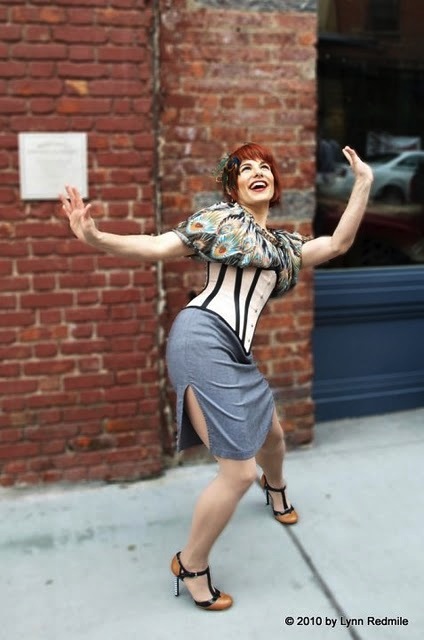
If there's anything I want to "steal" from Evita, it's her vitality and energy. (see above) Dancing with her (or just watching her dance) never fails to bring a smile to my face. She's completely approachable and very friendly; she has a way of finding inspiration from every other dancer she encounters. She's clearly in love with dance and it shows.